Friday, October 3, 2008

Today in history
Lincoln at Antietam

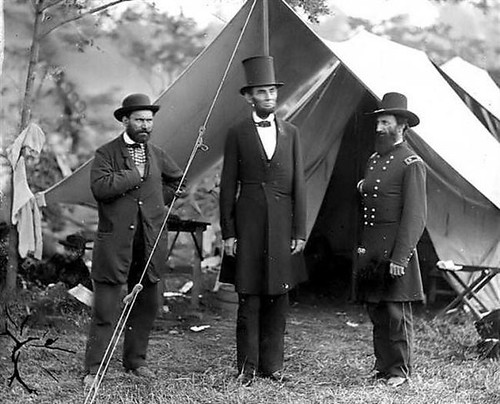
Abraham Lincoln, October 3, 1862 on the Battlefield of Antietam. This is perhaps the best outdoor portrait of Lincoln. He is shown standing next to Allan Pinkerton (Left) and General McClernand (Right).

The Battle of Antietam was the bloodiest day in American History. There were 23,000 casualties in one day . . . four times the casualties suffered during the D-Day invasion. The Battle of Antietam was one of the defining moments in American History.

In the fall of the year 1862, Abraham Lincoln had become desperate for a victory in the Civil War. Up to that time, the South had achieved victory after victory. Bull Run, Wilson's Creek, and Shiloh had all been convincing victories for the South. Abraham Lincoln realized that if the North did not achieve a victory soon, the survival of the Union would be in doubt. This led Abraham Lincoln to look to God and make an offer . . . Lincoln prayed that if God would grant him victory on the battlefield, he would free the slaves.

Slavery had haunted Lincoln for some time. He fully realized the cruelty and brutality of this corrupt institution, but he did not have the strength to stand up against it. Desperate for a victory, he made the deal with God. Shortly after this, he received news of McClellan's success at Antietam. Despite devastating losses, McClellan was able to drive Lee out of Maryland, and back into Virginia. The battle of Antietam was fought on September 17, 1862. On September 22, 1862 Abraham Lincoln honored the promise he made to God, and issued the Emancipation Proclamation.

Tuesday, August 5, 2008

Tiger vs Toyger

Toygers vs Tigers


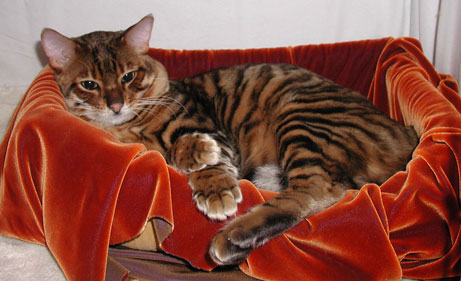
Sumatra, a registered "toyger," displays the rusty colored fur and unique black stripes of the relatively new breed.

Toygers have been registered with the International Cat Association (TICA) since 1993. This May they will join more familiar purebred felines, such as Persians and Siamese, that can be judged as championship cats at TICA-sponsored cat shows.

Toyger creator Judy Sudgen said she hopes the playful pets will inspire more people to care about wild tiger conservation.

"We use part of the price of the kittens to help the conservation of tigers, since that's our inspiration," she said.

For now the toyger is a work in progress, and fanciers hope to produce cats that more closely resemble tigers within the next few years.

One Big Egg!!

bigegg2

Wow! That's one big egg!
Is it real?

bigegg4

Yes it is...
Oh hey, here's another one.

egg6

These are eggs laid by Vorompatra (a.k.a. Aepyornis; Elephant Bird; Vouroupatra/Vouron Patra) - The largest bird known to science.

AepyornisLg

The Vorompatra (Aepyornis maximus) roamed the woodlands, marshes, and sand dunes of Madagascar until its relatively recent extinction. The bird laid the largest eggs known to have ever existed; these eggs may have inspired tales of the mythical elephant-lifting bird, the Roc (or Rukh) of the Arabian Nights. Man arrived on Madagascar about two millennia ago; hunting, egg predation, and gradual loss of habitat to agriculture all probably contributed to the demise of this ten foot tall, half-ton avian wonder.

ebird1

Did Vorompatra really look like this picture? No one knows for sure.

aepyornis-maximus550

Maybe he looked more like this.

flsPolish

Or this.

skeletonbig

Vorompatra was a ratite, a bird which could not fly because its breast bone had no keel (the term derives from ratis, Latin for "raft"). This "keel" serves to anchor the strong musculature other birds need for powered flight. Flightless birds evolved early in the Cenozoic Era, when the departure of their dinosaur ancestors cleared the stage for the evolution of new megafauna--mammals and birds were free to move into the niches so long occupied by the "Terrible Lizards". Other ratites are still found throughout the southern hemisphere; this circumstance gave rise to the "traditional" theory that these birds originated on the former continent of Gondwana, but the lack of key supporting evidence for this idea calls it into question.

eggpic01

Here is an egg comparison created by the Wyoming Dinosaur Center
Eggs of various modern reptiles and birds:
Clockwise from the upper-left:

  • an ostrich egg
  • crocodile eggs
  • one set of tortoise eggs
  • another set of tortoise eggs
  • and an Aepyornis Maximus egg
    (the extinct Elephant Bird of Madagascar).

All based on the same scale.
The ostrich egg is 145mm long.

egg1

Cool, huh?

You've been marked on my map!

You've been marked on my visitor map!